Nicaragua sits below the radar for most remote workers planning a move in Central America. Costa Rica gets the press. Panama gets the financial infrastructure. Nicaragua gets overlooked, which is precisely what makes it worth taking seriously.
The country has a Pacific coast with consistent surf, a cost of living well below its neighbors, and pockets of genuine nomad infrastructure in a landscape that has not yet been reshaped by mass tourism. It is not the easiest place to arrive without preparation. But for remote workers willing to plan ahead, it delivers a quality of daily life that is hard to replicate at the same price point anywhere else in the region.
Why Nomads Are Looking at Nicaragua
The comparison with Costa Rica comes up constantly, and for good reason. Both countries share a Pacific surf coast, a tropical climate, and a growing population of foreign remote workers. The difference shows up in your monthly bank statement. Accommodation, food, and coworking in Nicaragua typically cost 30 to 40 percent less than equivalent options across the border.
The other factor is space. Nicaragua’s coastal areas are noticeably less crowded than the established nomad hubs of Southeast Asia or the parts of Central America that absorbed the post-pandemic remote work wave. The surf breaks are less competed for. The towns have not been built around the tourist economy to the same degree. That will shift over time. This moment is worth paying attention to.
Visa and Entry: What You Need to Know
Nicaragua does not have a dedicated digital nomad visa. For most nationalities, entry is handled through a tourist visa granted on arrival, valid for 90 days. The process is straightforward, but the regional visa rules require a closer look before you plan any extended stay.
- Tourist visa on arrival: most passport holders receive 90 days. Entry fees vary by nationality and point of entry. Some nationalities receive 30 days with an option to extend within the country.
- CA-4 agreement: Nicaragua is part of a regional agreement with Honduras, El Salvador, and Guatemala. If you enter any of these four countries, the 90-day clock starts from your first entry into the CA-4 zone, not from your arrival in Nicaragua specifically. Moving between the four countries does not reset it.
- Renewal: to reset the 90-day clock, you need to exit the CA-4 zone entirely, typically by traveling to Costa Rica or Belize and re-entering. Most nomads spending longer periods in Nicaragua plan a border run every 90 days or arrange a residency option for stays beyond six months.
- Temporary residency: available for stays of one to two years. Requires documented income, a local legal process, and several months of processing time. Worth initiating before you arrive if this is your plan.
- Permanent residency: Nicaragua offers a residency category requiring a minimum monthly income of $600 from a stable source. Application fees run around $195 and processing typically takes four to six weeks. More relevant for nomads committing to a long-term base than for those testing a shorter stay.
For a first visit of one to three months, the tourist visa handles everything. For longer commitments, residency planning is worth doing in advance.
What It Actually Costs to Live in Nicaragua
The numbers below reflect real monthly costs for remote workers. They vary by location: coastal towns carry a small premium over inland cities, and the all-inclusive model at ESC in Popoyo represents a different structure altogether.
| Monthly lifestyle | Estimated cost | What it covers |
| Modest | $900 – $1,200 | Basic accommodation, local meals, occasional coworking, scooter rental |
| Comfortable | $1,300 – $1,600 | Better accommodation, mix of local and restaurant dining, regular coworking access |
| All-inclusive at ESC | From $1,955/month | Room, all meals and coworking, plus your choice of yoga, massages or surf sessions |
Accommodation: the largest variable in any budget. Rooms in shared houses or local guesthouses run $300 to $500 a month in most towns. Studio apartments or quality coliving setups range from $800 to $1,500 depending on location and standard.
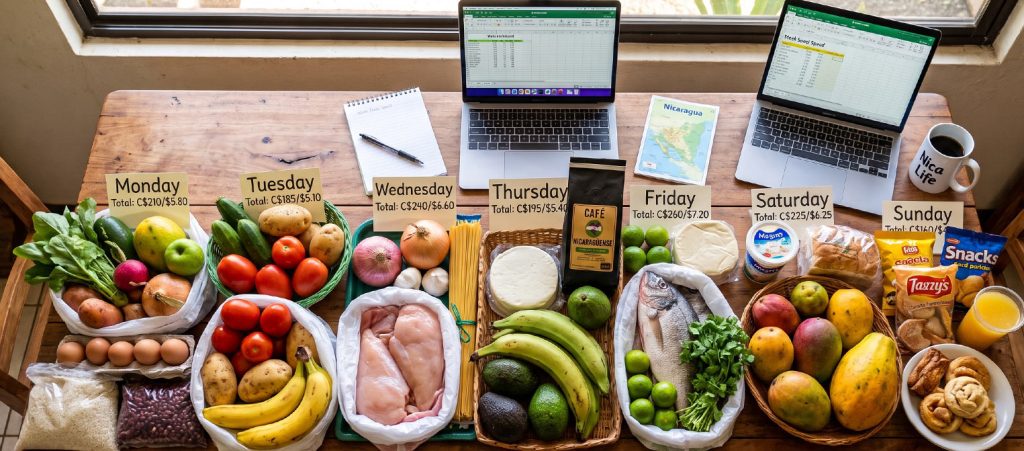
Food: local restaurants and family-run eateries serve full meals for $3 to $8. Sit-down restaurants aimed at international visitors charge $10 to $18 per plate. Shopping at local markets is the most affordable option: a weekly food shop for basics runs $20 to $40 and the produce quality is consistently good.
Coworking: day passes in dedicated spaces run $8 to $15. Monthly memberships cost $100 to $150 in most areas. ESC’s community membership in Popoyo is $150 per month and includes coworking access, pool, events, and shuttle use.
Transport: scooter rental is the standard for moving around coastal towns, at roughly $12 to $15 per day or $150 to $200 per month. Shared shuttle services connect the main nomad areas. The transfer from Managua’s international airport to the Popoyo area costs approximately $100 to $120.
Activities: surf lessons run $30 to $45 per session. Board rental is around $10 per day. Yoga classes cost $8 to $12. These are among the lowest prices for comparable activities anywhere in Central America.
Internet in Nicaragua: The Honest Picture
Connectivity in Nicaragua is not uniform, and setting the wrong expectations here would be doing you a disservice.
In cities and dedicated coworking spaces, fiber connections are available and generally reliable. In residential properties, quality varies significantly depending on the provider, the neighborhood, and the building. In rural and coastal areas, residential internet is less consistent, and mobile data often becomes the practical fallback for anyone working outside a coworking space.
| Setting | Connectivity | Notes |
| City coworking (Managua, León) | Strong, reliable | Fiber available, backup power in professional spaces |
| San Juan del Sur coworking | Variable | Reliable in dedicated venues, inconsistent in cafes and guesthouses |
| Residential rental (any area) | Inconsistent | Depends heavily on provider and specific location |
| Rural or coastal residential | Often limited | SIM hotspot frequently needed |
| ESC Coworking Center, Popoyo | Strong and stable | Fiber + backup generator, purpose-built workspace |
For anyone whose work cannot tolerate connectivity interruptions, a dedicated coworking space is not optional in Nicaragua: it is the baseline. A local SIM card from Claro or Tigo provides useful mobile data backup for working outside the office, though rural coverage varies by area.
ESC’s coworking center at La Jolla runs on high-speed fiber with a backup generator that eliminates outages as a concern. It is the most reliable remote work setup in the Popoyo area and one of the most reliable in the country outside a major city.
The Main Bases for Digital Nomads in Nicaragua
Three areas consistently stand out for remote workers looking for a base. They suit different working styles and lifestyle priorities, and the right one depends on what you are actually optimizing for.
San Juan del Sur
San Juan del Sur is the most established destination for foreign visitors on Nicaragua’s Pacific coast. The town has surf schools, hostels, restaurants, a recognizable international social scene, and the kind of infrastructure that makes a first visit to the country relatively straightforward.
For short stays or for nomads who want an active social environment, it works well. Internet in dedicated coworking spaces is reliable. In guesthouses and cafes, it is more variable. Monthly accommodation costs sit at the higher end of the Nicaraguan range, from $600 to $1,000 for a decent private room. The main limitation for sustained remote work is the atmosphere: San Juan del Sur is built around tourism and nightlife, which is good for meeting people but can make the consistent daily routine that productive remote work requires harder to maintain.
León
León appeals to a different profile. Nicaragua’s second city is a university town with colonial architecture, a strong cultural identity, and a cost of living lower than the coastal towns. It has fewer dedicated nomad amenities than San Juan del Sur, but it has working cafes, a handful of coworking options, and a local rhythm that feels genuinely Nicaraguan rather than export-facing.
For nomads who want to be immersed in the country rather than insulated from it, León is the more compelling choice. The Pacific coast is accessible by road but not a short trip from the main surf breaks of the Rivas department. Monthly accommodation in León runs from $400 to $700 for a decent setup, making it the most affordable of the three areas.
Popoyo
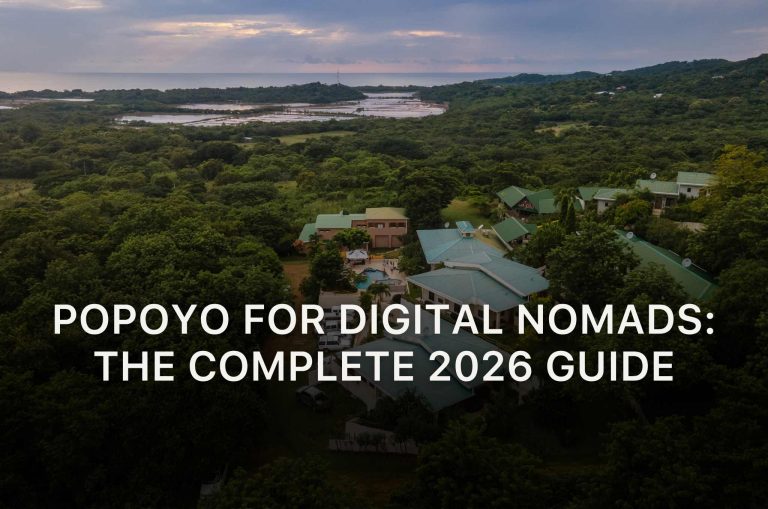
Popoyo offers what the other two areas only partially deliver: reliable coworking infrastructure in a Pacific coastal setting with direct access to consistent surf. The area sits on the Emerald Coast in the Tola region, away from the established tourist circuit, and has a pace and density of development that reflects how early the location still is relative to its potential.
The trade-off is logistics. Popoyo is more remote than San Juan del Sur, requires more advance planning for self-sufficient living, and has fewer independent options than a larger town. What it has instead is ESC Digital Nomad Village, which addresses most of those logistics in one place. Managua is approximately two to three hours by road. The nearest town for daily services is Rivas.
ESC Digital Nomad Village: What the All-Inclusive Model Looks Like
Most nomads who arrive in Nicaragua spend their first week solving the same set of problems: finding a place with reliable internet, locating somewhere to eat consistently, sorting transport between the workspace and the beach. In a country where logistics require more advance thinking than in an established hub, that setup time is not trivial.
ESC takes a different approach. Here is a full overview of what the village includes.
La Jolla and Magnific Rock
ESC operates across two sites in the Popoyo area, connected by a free community shuttle running throughout the day.
La Jolla is the mountain-side base. It houses the coworking center, a hotel with studio apartments, El Tigre (an Asian fusion restaurant), The Grind Cafe for coffee and fresh juices, an outdoor gym, a pool, a sauna, a yoga space, a community garden supplying produce for the kitchen, a health and wellbeing clinic, and a small commercial plaza for daily essentials. Most of what you need for a full working day is within a short walk.
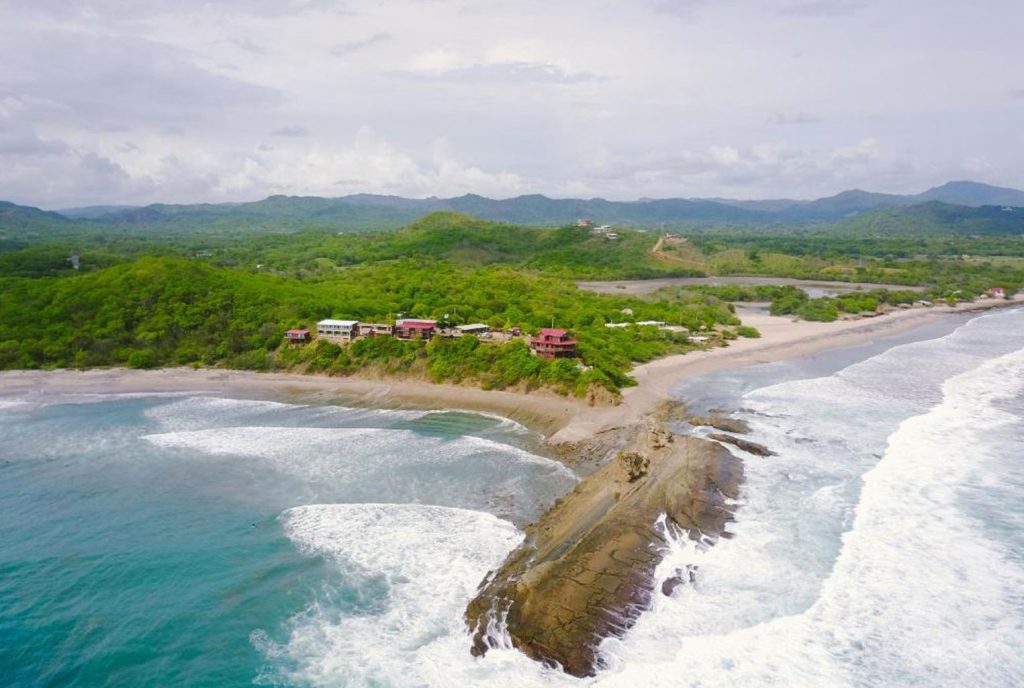
Magnific Rock is the beach resort, ten minutes away by shuttle. It sits above Playa Guasacate and gives access to the ocean, the pool, daily yoga sessions, and the slower morning rhythm that comes with being steps from the water. Playa Popoyo, one of the most consistent surf breaks on the Central American Pacific coast, is directly accessible from here.
Workspace and Connectivity at ESC
The coworking center at La Jolla is built for full working days, not two-hour laptop sessions. Air conditioning, ergonomic workstations, private meeting rooms for calls, and high-speed fiber internet backed by a generator. Power outages in rural Nicaragua are not constant, but they happen, and a generator removes them as a variable entirely.
The physical separation between workspace and the rest of the village is deliberate. The coworking center is where you work. The rest of ESC is where you stop working. That boundary is more valuable than it might seem when you are trying to sustain a productive rhythm for a month or longer.
Packages and What They Include
All-inclusive packages cover accommodation, all meals and full coworking access, plus your choice of yoga classes (three a week), massages or surf sessions. A week starts at $550 per person, two weeks at $1,050 and a month at $1,955 (twin room). No separate charges for the core daily amenities.
For those already based in the Popoyo area, a community membership provides access to the coworking space, pool, events, and the shuttle: $10 per day, $40 per week, or $150 per month.
See the full details of each package and what is included.
Who It Works For
The people who get the most out of ESC tend to arrive with a specific frustration. Some are professionals who recently went remote and want a structured environment while they settle into the lifestyle. Some are experienced nomads who are tired of reassembling the same basic setup in every new country. Some are traveling as a couple or with a colleague and want a place where both people can work effectively while still having a life outside the laptop.
ESC is not suited to everyone. If you need to be in a major city, close to an international airport, or working in a European timezone with early morning overlap requirements, Popoyo is not the right fit. But for nomads oriented toward the Pacific, looking for community and reliable infrastructure in a remote setting, it is one of the few places in Central America where all of that is ready on arrival.
If you are weighing it up and have specific questions, reaching out to the ESC team directly is the most direct next step.

Practical Logistics for Living in Nicaragua
Banking and cash: Nicaragua operates largely on cash. ATM access can be limited depending on your card issuer and the area you are in, and it is worth confirming compatibility with your bank before you travel. Arriving with USD is strongly advisable, particularly if you are heading to rural or coastal destinations. Larger towns and cities have ATM coverage, though availability is not guaranteed.
Healthcare: for routine consultations, local clinics in the Rivas area cover most needs at low cost. Doctor consultations typically run $25 to $70. ESC has a health and wellbeing clinic on-site at La Jolla for residents. For anything requiring specialist attention or diagnostic equipment, Managua is the practical destination and roughly two to three hours from Popoyo by road.
Getting around: shared shuttles connect the main nomad areas and are the standard option for inter-city travel. Private taxis and transfers are available for airport runs and longer journeys. Scooter rental handles most local movement in coastal towns. ESC’s community shuttle runs between La Jolla and Magnific Rock throughout the day at no additional cost.
Daily supplies: basic groceries, pharmacy items, and everyday necessities are available in Rivas, a short drive from Popoyo. San Juan del Sur and León have more developed commercial infrastructure for those based in those areas. Specialist items or larger shopping runs require a trip to Managua.
Is Nicaragua the Right Base for You?
Nicaragua works well for some nomad profiles and is clearly not suited to others. This is an honest read of both sides.
| It tends to work well if you | It is probably not the right fit if you |
| Want significantly lower costs than Costa Rica or Panama | Need to be close to a major international airport |
| Are oriented toward Pacific surf and outdoor lifestyle | Require daily access to a large city’s infrastructure |
| Can plan logistics in advance: cash, transport, entry rules | Are working in a European timezone with early morning overlap |
| Want a ready-made community and structured setup at ESC | Prefer total independence with no shared spaces or schedules |
| Are planning a stay of one month or more | Are looking for a one-week working trip rather than a real base |
| Are comfortable with some variability outside dedicated coworking | Cannot tolerate any internet uncertainty outside a professional space |
The clearest version of living in Nicaragua as a remote worker is Popoyo with ESC. The all-inclusive setup removes the main friction points of a rural coastal destination and replaces them with a structure that works from day one.
Frequently Asked Questions About Living in Nicaragua as a Digital Nomad
No. Nicaragua does not currently offer a dedicated digital nomad visa. Under the immigration updates, entry requirements depend strictly on your nationality: Category A passport holders (including the US, Canada, EU, UK, and Australia) can enter visa-free for up to 90 days by purchasing a $10 tourist card upon arrival. However, many other nationalities (Category C, which now includes Mexico and Peru) must apply for a Consulted Visa online prior to travel. The 90-day clock covers the CA-4 regional agreement (Nicaragua, Honduras, El Salvador, and Guatemala) collectively, meaning moving between these borders does not reset your time. Stays can be extended internally at immigration offices for an additional 30 days for a fee, but for long-term stays, exiting the CA-4 zone (a “border run”) or pursuing a temporary residency permit are the realistic options.Does Nicaragua Have a Digital Nomad Visa?
A modest but functional lifestyle, including basic accommodation, local meals, and occasional coworking access, typically runs $900 to $1,200 per month. A more comfortable setup with better accommodation and regular coworking comes in at $1,300 to $1,600. ESC’s all-inclusive packages at Popoyo start at $1,955 per person per month for a twin room and cover accommodation, all meals and full coworking access, plus your choice of three yoga classes a week, four massages or four surf sessions with no additional charges for the day-to-day basics.How Much Does It Cost to Live in Nicaragua as a Digital Nomad?
Reliable in dedicated coworking spaces; variable everywhere else. In cities, fiber is available and generally stable. In residential rentals, quality depends on the provider and the specific location. In rural areas, mobile data is often the practical fallback. For anyone whose work requires consistent connectivity, a dedicated coworking space is the baseline, not an optional extra. ESC’s coworking center at La Jolla runs on fiber with a backup generator, making it one of the most reliable setups available outside a major Nicaraguan city.How Is the Internet in Nicaragua for Remote Work?
It depends on your priorities. San Juan del Sur is the most accessible entry point, with an established social scene but inconsistent internet outside dedicated workspaces. León offers lower costs and a more local atmosphere, with a smaller nomad infrastructure. Popoyo, specifically through ESC Digital Nomad Village, is the strongest option for anyone prioritizing a structured work environment alongside Pacific lifestyle access. It has the most reliable coworking infrastructure in the region and a built-in community of remote workers already in place. .What Is the Best Area in Nicaragua for Digital Nomads?