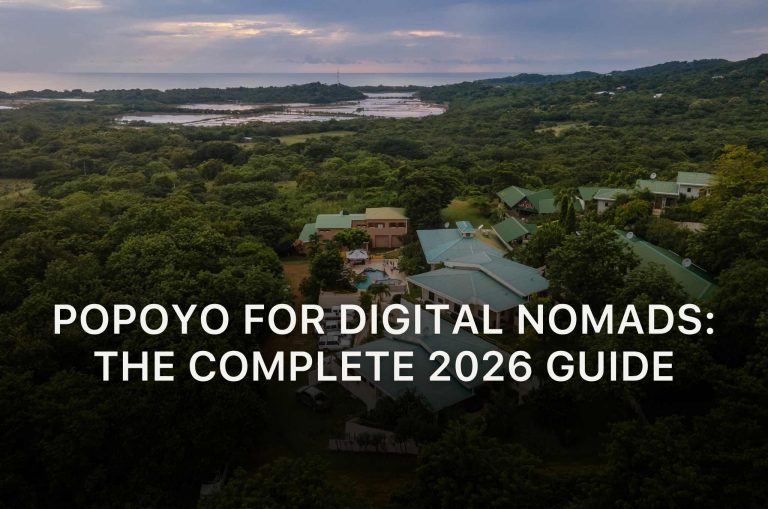
Finding a place that genuinely works for both surfing and remote work is harder than the lifestyle content suggests. Most surf towns have the ocean. Fewer of them have the internet reliable enough for a full working day, a workspace that supports sustained concentration, and a daily structure that keeps both the work and the water from suffering.
This guide was built on that specific intersection. Not surf quality alone, not just nomad infrastructure, but the actual combination of the two: places where you can be in the water at sunrise and productive at a desk by nine. Some of the destinations below are well established. One is in Central America, consistently underrepresented on these lists, and stronger on both criteria than most of the places that appear above it everywhere else.
What Separates a Good Surf Destination from One That Actually Works
Most surf destination guides are written for surfers. They cover wave quality in detail and mention the internet as an afterthought. For remote workers, that framing creates a problem: a destination that delivers great surf but undermines your productivity is not a sustainable base. It is an expensive holiday with a deadline looming over it.
Six factors determine whether a surf destination actually functions for remote work alongside regular time in the water:
- Wave consistency: not just quality but reliability. A break that fires three or four days a week is more useful for building a routine than a world-class wave that requires a specific swell direction. Knowing which you are dealing with changes how you plan your week.
- Internet reliability: fiber-backed coworking spaces are the standard. Residential and cafe connections in coastal towns frequently disappoint, especially at peak hours.
- Backup power coverage: outages are more common in coastal and rural settings than in cities. A generator at your workspace converts a recurring disruption into a non-event.
- Workspace quality: ergonomic seating, acoustic privacy for calls, and physical separation from the social areas of wherever you are staying. These matter considerably for sustained eight-hour output.
- Full monthly cost: the real number, not just rent. Coworking membership, surf lessons, food, and transport compound quickly. Many surf destinations look affordable until you price everything separately.
- Community: proximity to other nomad-surfers raises the quality of both the social environment and the accountability. A shared commitment to surfing and working well creates a different dynamic than a location where those two groups rarely overlap.
The Primary Pick: Popoyo, Nicaragua
Most of the destinations that dominate the surf nomad conversation are in Southeast Asia or Western Europe. Popoyo, on Nicaragua’s Pacific Emerald Coast, does not appear often on those lists. That is part of why it leads to this one.
The Tola region of Nicaragua’s Rivas department delivers two things in combination that are genuinely rare: world-class, year-round Pacific surf and purpose-built digital nomad infrastructure at a cost that undercuts every other destination on this page. Central America’s surf has been known to serious wave-seekers for decades. The coworking infrastructure is newer, and the way ESC Digital Nomad Village has assembled it changes the calculus for remote workers specifically.
The Waves
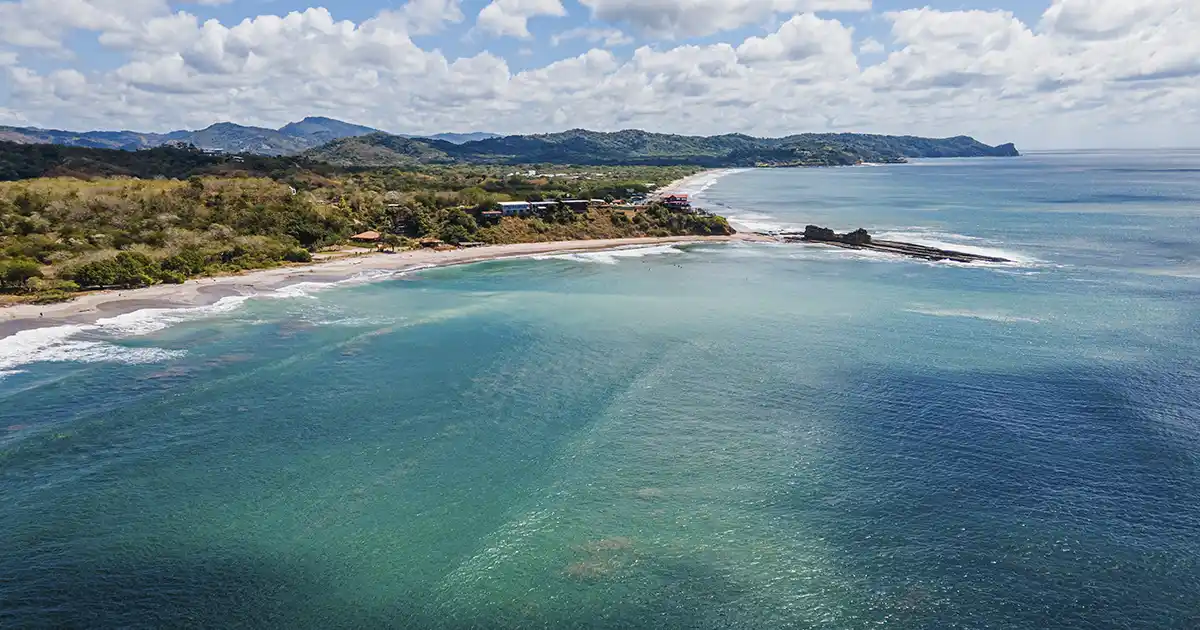
The Popoyo area offers several distinct breaks within easy reach of each other, which gives it more flexibility than a single-wave destination.
Playa Popoyo is the main draw: a reef break with genuine power and shape, suited to intermediate and advanced surfers. When the swell cooperates, it delivers the kind of wave that justifies a long trip. Playa Guasacate is the more accessible beach break, working across a wider range of conditions and skill levels, and the more consistent daily option for most nomads. Beginner Bay is sheltered and forgiving, used for lessons and for surfers still building their base. La Lejana provides a quieter alternative for those willing to explore a short distance further.
The area surfs year-round. From November to April, the dry season brings offshore morning winds that clean up the surf into well-shaped, readable conditions. Swells tend to be smaller and more predictable, which suits consistent daily sessions. From May to October, the rainy season delivers larger and more powerful swells. Afternoon showers are common but rarely sustained through the morning session. For nomads chasing size, this window is significantly undervalued.
The Work Infrastructure
This is where Popoyo separates itself from most surf destinations, including the well-known ones.
ESC Digital Nomad Village operates a dedicated coworking center at its La Jolla base, ten minutes from the beach by the village’s free community shuttle. The space runs on high-speed fiber internet backed by a generator that covers any power interruptions. It is air-conditioned, equipped with ergonomic workstations and private meeting rooms for calls, and architecturally separated from the living and social areas of the village.
For nomads who need to produce serious output after getting out of the water, that last point matters more than any individual spec. A workspace designed for eight-hour working days is a different thing from a cafe with decent wifi near a surf break.
How ESC Solves the Surf and Work Equation
The standard surf nomad setup requires coordinating several pieces simultaneously: somewhere to surf, somewhere to work reliably, somewhere to sleep and eat, a wellness routine, and a social environment. In most destinations, those pieces come from different sources across a rural or semi-developed area, and managing them takes real time and energy.
ESC removes that coordination layer entirely.
La Jolla, the village’s mountain-side base, houses the coworking center, a hotel with studio apartments, El Tigre (an Asian fusion restaurant), The Grind Cafe for coffee and fresh juices, an outdoor gym, a pool, a sauna, a yoga space, a community garden that supplies the kitchen, a health and wellbeing clinic, and a commercial plaza for daily needs. Magnific Rock, the beach resort ten minutes away by shuttle, sits directly above Playa Guasacate. Playa Popoyo, the area’s main reef break, is directly accessible from there.
The daily rhythm this enables is not theoretical. Surf at dawn. Cowork through the morning in a purpose-built workspace with reliable fiber. Eat from the kitchen. Back in the water or on a yoga mat by late afternoon. That sequence does not require navigating three separate providers across a rural coastal destination.
Explore everything ESC includes across both locations.
Packages and Pricing
All packages include accommodation, all meals and full coworking access, plus your choice of yoga classes (three a week), massages or surf sessions. For surfers, the surf sessions are one of the included options, so time in the water is part of the package. A week starts at $550 per person, two weeks at $1,050 and a month at $1,955 (twin room).
For nomads already based in the Popoyo area, a community membership covers the coworking center, pool, events, and shuttle: $10 per day, $40 per week, or $150 per month.
See the full package details and what is included.
If you are weighing Popoyo against other options and want specifics before committing, the ESC team answers questions directly.
The Established Surf Nomad Hubs
These five destinations appear on every list for good reason. They have track records, developed infrastructure, and genuine wave quality. Each one also has trade-offs that are worth naming honestly.
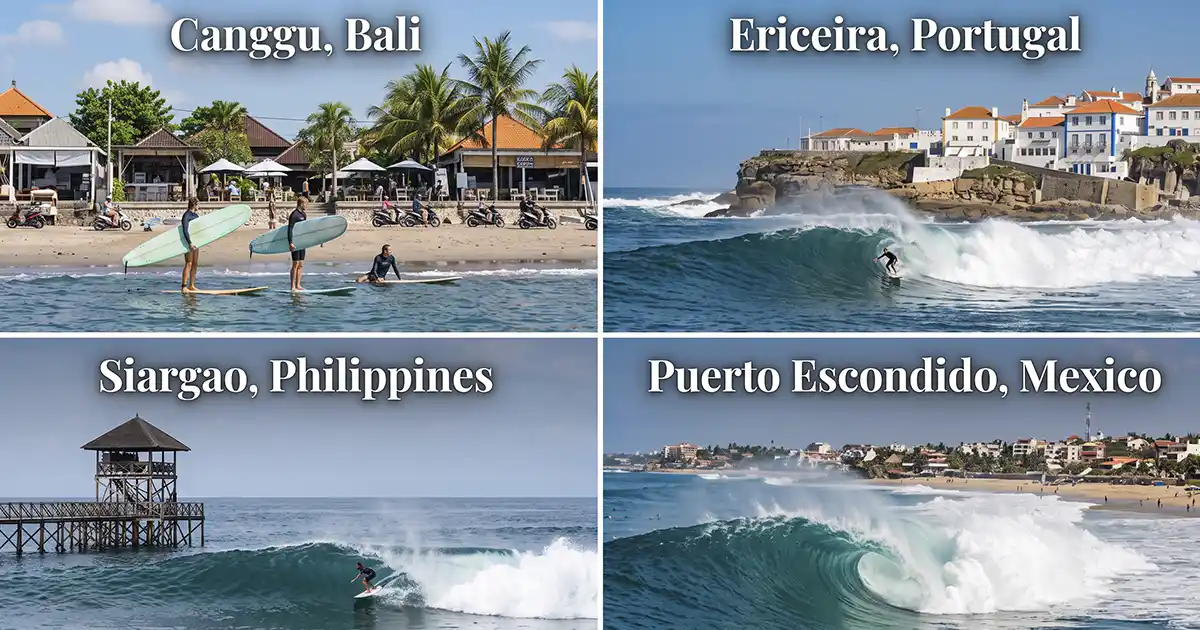
Canggu, Bali, Indonesia
Bali is the benchmark against which every other surf nomad destination gets measured, and Canggu is where that reputation lives. The density of coworking spaces, surf schools, coliving options, and cafes in a single area is hard to match anywhere in the world. The breaks range from gentle beach breaks for beginners through to more demanding reef waves for experienced surfers. Internet in dedicated coworking spaces is reliable, the social scene is enormous, and the cost of living, while no longer as low as it once was, remains competitive.
The trade-offs are real. Canggu has become noticeably more crowded and more expensive since 2020. The main lineups are busy. Visa logistics for anything beyond 60 days require planning. For first-time surf nomads, it remains one of the most practical starting points available: everything is already there, the learning curve on logistics is low, and the community is self-replenishing. For those who have done the Bali circuit more than once, the feeling of saturation is increasingly hard to ignore.
Ericeira, Portugal
Ericeira is one of only a small number of World Surfing Reserves globally, and the break variety reflects that designation. Multiple reef and point breaks sit within a short drive of each other, covering skill levels from beginner to professional. The European timezone is a significant practical advantage for any nomad working with European or US East Coast clients. Portugal’s digital nomad visa allows stays of up to a year for those who qualify, which removes one of the recurring frustrations of surf nomad life.
The main friction points: the water is cold year-round, requiring a wetsuit for most sessions regardless of season. The best conditions are highly seasonal, with autumn and winter delivering the most consistent quality. Costs in Portugal have risen considerably since 2022, though Ericeira remains more affordable than Lisbon. The nomad community is active and well-organized, but smaller and more seasonal than Bali’s.
Siargao, Philippines
Siargao’s Cloud 9 is one of the most recognizable waves in the world: a powerful, barreling reef break that draws experienced surfers from across the globe. The island has developed a coworking and coliving ecosystem in recent years, and the cost of living is among the lowest on this list. The people who make it to Siargao tend to be committed to both the surf and the lifestyle, which creates a self-selecting community that is notably high-energy.
The trade-offs are logistical. Getting there requires effort: international connections route through Manila or Cebu, adding travel time and cost. Internet outside dedicated coworking spaces is variable and can be unreliable. The typhoon season from roughly July to November brings the most powerful surf conditions but also significant weather disruption. Nomads willing to build their schedule around those realities find Siargao delivers at a level few destinations match.
Puerto Escondido, Mexico
Puerto Escondido’s main break, the Mexican Pipeline, is one of the heaviest beach breaks in the world. It is fast, shallow, and unforgiving. For advanced surfers who want genuine challenge, it is worth the trip on wave quality alone. The town around it has grown into a functional nomad base: accommodation at various price points, a developing coworking scene, a strong food culture, and a timezone that aligns well with US and Latin American clients.
Internet outside dedicated spaces has historically been one of Puerto Escondido’s weakest points, though Starlink availability has improved the situation in recent years. The town has become considerably more expensive and more crowded since 2021, and the wave is not suited to anyone below a confident intermediate level. For nomads who want a world-class wave with an active foreign community, it remains a strong option with real caveats.
Tamarindo, Costa Rica
Tamarindo offers a combination of consistent surf, good infrastructure, and one of the most established foreign communities in Central America. The waves are forgiving enough for a wider range of surf levels, and the town’s developed expat economy means reliable services, fast internet in coworking spaces, and an English-speaking environment that is easy to navigate from day one.
The main drawback is cost. Costa Rica is substantially more expensive than Nicaragua, Colombia, or Southeast Asia, and Tamarindo in particular reflects its popularity in its pricing. Accommodation, food, and activities all carry a premium compared to what the same money buys elsewhere in the region. For nomads on a budget, it works better as a short exploratory stay than as a long-term base. For those with more flexibility on monthly spend who want the Guanacaste coastline, it delivers reliably.
Other Destinations Gaining Ground for Surf Nomads
These locations have not yet reached the infrastructure density of the destinations above, but each has genuine surf and remote work potential that is worth tracking in 2026.
| Destination | Region | Surf level | Internet | Est. monthly cost | Best for |
| Da Nang, Vietnam | Southeast Asia | Beginner to intermediate | Good, improving | $700–$1,000 | Budget, beach access, city infrastructure |
| Florianópolis, Brazil | South America | Intermediate to advanced | Reliable in coworking | $1,000–$1,400 | South American surf scene, affordability |
| Cabarete, Dominican Republic | Caribbean | Wind and kite-focused | Variable | $800–$1,200 | Wind sports, Caribbean lifestyle |
| Tamraght, Morocco | North Africa | Beginner to intermediate | Improving | $600–$900 | Budget, Atlantic swells, EU timezone proximity |
Da Nang has the advantage of a real city around it: hospitals, supermarkets, and transport infrastructure alongside the beach and an improving surf scene. Florianópolis is underrated on the international nomad circuit but has an established local surf culture and a cost of living that remains below São Paulo or Rio. Cabarete is more relevant for wind sports than traditional surfing but has a strong international community and genuine Caribbean lifestyle access. Tamraght, in southern Morocco, is one of the most affordable surf destinations on any continent and is increasingly attracting nomads looking for Atlantic swells without European prices.
All four require more self-sufficiency than the primary destinations on this list. They suit nomads comfortable with assembling their own setup.
How to Match a Surf Destination to How You Work
The right destination depends on three things: your surf level, your work requirements, and how much environmental structure you need to stay productive.
| Your situation | Worth considering |
| You need EU or US East Coast timezone overlap | Ericeira, Tamarindo, Puerto Escondido, Popoyo |
| You want maximum nomad infrastructure and wave variety | Canggu, Bali |
| You want the best surf quality at the lowest cost | Popoyo, Siargao |
| You want surf, work, meals, and wellness fully integrated | ESC at Popoyo |
| You are new to surfing and want lessons plus structure | Popoyo (Beginner Bay + ESC surf sessions), Canggu, Tamarindo |
| You want advanced or expert-level breaks | Siargao (Cloud 9), Puerto Escondido, Popoyo (reef) |
| You are doing a first surf nomad stay and want to test the format | ESC’s weekly or two-week package |
| Budget is the primary constraint | Popoyo, Tamraght, Da Nang |
If internet reliability alongside wave quality is your main constraint, the field narrows quickly. Fiber-backed coworking with generator coverage at an actual surf destination is a short list. ESC at Popoyo is the most complete version of that combination currently available in Central America, and one of the most complete anywhere.
Frequently Asked Questions About Surfing as a Digital Nomad
It depends almost entirely on whether you use a dedicated coworking space or rely on your accommodation’s residential connection. In most surf destinations, cafes and guesthouses offer internet that is adequate for email but not for sustained professional use or regular video calls. In established nomad hubs like Canggu and Ericeira, dedicated coworking spaces offer fiber speeds that hold up under professional load. In more remote settings like Popoyo, the distinction matters even more: ESC’s coworking center at La Jolla runs on fiber backed by a generator, which makes it more reliable than many residential options in much larger cities. The rule holds everywhere: do not rely on your accommodation’s wifi as your primary work connection at a surf destination.Do Surf Destinations Have Reliable Enough Internet for Remote Work?
Yes, consistently, provided the structure around you supports it. The nomads who maintain strong professional output at surf destinations share a common pattern: they surf early, before the working day begins, rather than treating the session as a midday interruption. A 90-minute morning session followed by a full working block from nine to four is a far more effective rhythm than a fragmented schedule built around variable surf windows. Destinations with purpose-built coworking infrastructure, like ESC at Popoyo, support this architecturally: the workspace and the ocean access are both available, the daily transition between them is smooth, and the structure is already in place rather than something you have to engineer yourself.Can I Actually Be Productive While Basing Myself at a Surf Spot?
Every level on this list has good options. Complete beginners do best in destinations with gentle beach breaks and active surf schools: Canggu, Tamarindo, and Popoyo’s Beginner Bay all work well for this. Intermediate surfers have the widest range of options, since most destinations offer a mix of breaks that cover developing skills. Advanced surfers should prioritise Siargao’s Cloud 9, Puerto Escondido’s Pipeline, and Popoyo’s main reef break for genuine challenge and quality. ESC includes group surf sessions in all packages regardless of level, which means Popoyo functions as a practical starting point even for nomads who are surfing for the first time or returning after a long break.What Surf Level Do I Need to Enjoy a Surf Nomad Destination?
A month is the minimum that produces a real return on a surf nomad setup. Two weeks is long enough to find your feet and get regular sessions in, but not long enough to build the productive work rhythm that makes the lifestyle sustainable. A month gives you time to settle into a daily structure, understand the break conditions across different swell and wind variations, and make an honest assessment of whether the destination actually works for you. ESC’s weekly and two-week packages are built specifically for shorter exploratory stays: they give you the full structure of the all-inclusive setup while you decide whether a longer commitment makes sense for your work and surf goals.How Long Should I Plan to Stay at a Surf Destination?